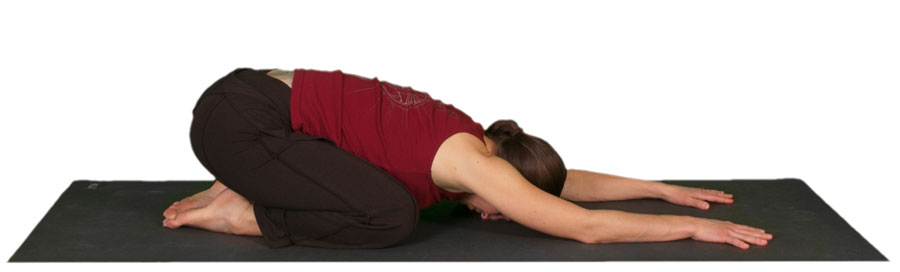
Yoga’s Niyamas: Ishvara-Pranidhana as Deep Devotion and Joyful Surrender

Posted By Katrina Ariel On December 17th, 2011

Complete surrender.

To me, Ishvara-pranidhana is the practice of total trust and alignment with the Divine, emanating a flawless faith that delivers you into complete connection and oneness of Universal and Individual.

It is utter devotion to the Divine, and absolute joyful surrender.

The Individual self completely gives itself over to the Universal.

And what happens is that, through this act of letting go, you experience a supreme wholeness and loving consciousness.

This union is beyond description, yet so many have tried to explain this experience that we call Enlightenment, Nirvana, or Samadhi.

And this is what yoga leads us to; what all the practices are guiding us towards so that we can know ourselves as complete beings, beyond the illusion of separation.

The Problem With Practicing Ishvara-Pranidhana

The problem most of us face with devotion and surrender is that, as humans, we tend to have trust and control issues.

If you just snickered or made a face, you’re probably recognizing this in yourself. I know distrust and control have been big themes in my own life.

These show up in myriad ways, but the fact of the matter is that when we have a hard time trusting ourselves, others, or the course of life, things are difficult. We worry more. We fight the flow of life. We don’t have as much fun and make things hard for ourselves.

Yet when you look at the big picture, Read more…


The Niyamas: Svadhyaya as Deep Study of the Self and Yoga

Posted By Katrina Ariel On December 10th, 2011

I've chosen these wonderfully beautiful images from outer space to inspire reflection upon the space within. When you get that big and consider the Universe, it often invokes self consideration as well.

“How far down the rabbit hole do you want to go?” asked Douglas Brooks in my first workshop with him, many years ago.

“All the way!” I responded enthusiastically.

We were studying a text called The Pratyabhijna-Hridayam. It’s a text that invites you into the heart of self-realization. It’s absolutely beautiful. And I still haven’t gotten all the way through it. Heh. One day…

Sometimes I feel like I could just open up the top of my head and let the information pour in. When I am passionate about something, I often study it intensely!

Of course, sometimes studying yoga can also be quite dense and hard to absorb. I remember reading the Shiva Sutras as one of the required books for Anusara® yoga certification.

The text was so dense that, with the summer heat and the comfort of the couch on my front porch, I often found myself needing a nap every 3 pages or so. It helped the information sink in, on some level at least.

The thing with deep wisdom, especially when it comes through an ancient, immensely powerful language like Sanskrit, is that one line can offer an incredible amount of information and you can contemplate it for a long time.

Though this article does speak mostly on the study of texts, really, self-study encompasses all of life. It is an attitude of awareness and willingness to perceive yourself and learn deeply from everything you encounter.

Svadhyaya, the fourth of the niyamas, is a deep study of the self, through contemplation, practice, and also via the vast wisdom contained in sacred texts.

How To Study Sacred Texts:

Let’s jump straight to Patanjali’s Sutra 2.44 and see what it has for us, shall we?

Svadhyayat ishtadevata sampryogah

Now, when studying texts like this, there is an order to things.

First, try out the taste of the sutra before actually getting all intellectual. Say it out loud a few times and see what it FEELS like, even if you don’t know its meaning.

Go ahead. I’ll wait…

“Svadhyayat ishtadevata sampryogah… Svadhyayat ishtadevata sampryogah… Svadhyayat ishtadevata sampryogah…”
Read more…


Yoga’s Niyamas: Tapas as Discipline Serving Delight

Posted By Katrina Ariel On November 26th, 2011

My very first yoga teacher, Patrick Creelman, using The Force.

Tapas could be thought of as the fire of alchemy of the niyamas. Yoga gives us so many ways to tap in to the powers of transformation, and tapas is a powerful force that can propel you to the next level… Whatever that is for you.

Tapas asks you to transform your practice, and by doing so, yourself, with the purifying heat of will power and intent.

In one sense, tapas is a very physical action of cleansing the body through the heat of practice and skillful choices about how you eat, how you breathe, how you’re sitting right now as you read this…

And yet the concept of tapas goes far beyond the physical into the entire being as the liberating idea of “Discipline serving Delight”.

I was first turned on to this totally new and radically different way of considering discipline in an intensive with John Friend back in 2008.

Recently, this quote has been floating around Facebook, inspiring many to revisit this line of thinking:

“How much do you want it? That’s how much effort you give to the desire. That’s the offering. It has to be equal.” -John Friend, founder of Anusara® yoga

How much do you want whatever it is you want?

How much do you want to be happy and content in your heart? How much do you want to be free from pain in your body?

How completely do you desire to live with the highest integrity and joy?

When you meet that deep yearning with an equal amount of effort and dedication, the results are tremendous! Read more…


Yoga and the Niyamas: Santosha as Deep Contentment

Posted By Katrina Ariel On November 19th, 2011

His Holiness the Dalai Lama is an incredible example of choosing an attitude of acceptance and contentment, even in exile and after living through so much. He carries this vibration of deep peace wherever he goes as he shares his message.

Yoga is a deep dive into the practice of equanimity, and santosha invites us to a level of contentment that is complete; a state where acceptance of the way things are creates a deep abiding peace.

The yamas and niyamas can guide the way to this state of peace and contentment, but it is your attitude as you practice and live that truly creates your experience.

And so, we each get to choose what kind of attitude we want to have.

Take my cat for example.

Jasmine, my rag-doll black and white kitty, has santosha down pat.

Admittedly, her life is ideal for this practice as she really doesn’t have any responsibilities other than being cute and cuddly, but not every cat has perfected the state of contentment like she has.

When I get too caught up in the ‘things to do’, or the busy-ness of every day life, Jasmine comes and sits on my lap, purrs, and basically says, “Chill out. It is what it is. Just breathe and be here in this moment with me. I love you. Be happy.”

Wise cat, eh?

Here’s the thing, when it comes to happiness, which is the goal of most human beings, santosha is the key.

“By contentment, supreme happiness is attained.” –John Friend, founder of Anusara® yoga translating Patanjali’s Yoga Sutra 2.42

What Does it Take to Create the Deep Contentment of Santosha? Read more…


Niyamas: Saucha as Clarity and Purity

Posted By Katrina Ariel On November 13th, 2011

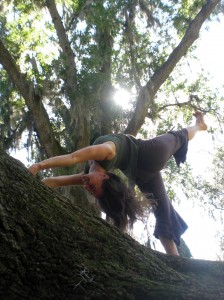
My friend Michele Baker (from Swan River Yoga in New Orleans) doing yoga in some exotic place. This gorgeous image shows balance, purity, and clarity in such a beautiful way.

Saucha is the first of the Niyamas, and it invites great freedom through the practice of creating balance and purity.

While the yamas give us way to live with high integrity and greater enjoyment in relationship with ourselves and the world around us, the niyamas are primarily focused on daily practices we do ourselves.

This blog post continues our conversation on the guiding ethical principles of yoga viewed through my own perspective, informed by the teachings of Anusara® yoga.

Saucha is a good place to begin when looking at your own personal practice, because it speaks to the importance of being organized and the far reaching benefits of cultivating purity internally and externally.

A couple simple examples: If your desk is a mess, how effective are you compared to when it is organized? If you’ve been eating ice cream and pizza, how do you feel compared to when you eat clean and healthy?

How do you feel when your house is clean and orderly versus when it looks like a clothing bomb exploded?

Fung Shui, which you’ve likely heard of since it’s popular all over the world for being effective, is a Chinese system of energetic and material organization that places high importance on clearing out space and being precise in how things are placed.

For instance, if you’ve got a pile of unused and randomly stored ‘stuff’ in the Wealth and Prosperity corner of your house, your Fung Shui consultant would tell you it needs to be dealt with in order to allow for full flow of abundance.

Hmmm… That sounds oddly familiar. Excuse me…

(30 Minutes Later)

Okay, I’ve cleaned out the corner. Energy pure and clear. Ready and open for full flow of abundance!

Saucha: Sparkling, Inside and Out

Really, this concept of creating clarity and purity in order to have more freedom and flow is reflected in EVERY aspect of life. Read more…


The Yamas: Aprigraha as Living Simply (Freedom From Suffering)

Posted By Katrina Ariel On November 5th, 2011

Aparigraha, the last of the yamas as defined in Patanjali’s Yoga Sutras, is a subtle and incredibly freeing concept, especially (at least for me) when we look at it through the lens of Anusara® yoga’s Shiva Shakti Tantrik philosophy.

We’ll explore aparigraha (non-clinging) as the act of Living Simply.

This isn’t a practice of renunciation, although some express it as such. Instead, to me, it is a conscious way of living finely, simply, without grasping…

It is living in the natural flow of abundance with great respect in relationship with what you have and that which is around you.

“When established in aparigraha you gain knowledge of the nature of the world (why and how). Don’t take more than you need. Live simply – this can be living finely, with sensitivity to the whole. When you are sensitive in resources and relationships you gain knowledge of how and why things are the way they are.” –John Friend, founder of Anusara yoga, interpreting Patanjali’s Yoga Sutra 2.39

Sitting next to my teacher at dinner last week, he gestured to his shirt and said, “You have nice things, but you need to be ready to give them away at any moment.”

Aparigraha encourages us to let go of the grasping, possessive, neediness that is at the root source of greed. It tells us that we are far more free when we don’t accumulate things beyond what is necessary.

When we live simply, even if that is living finely in luxury, we choose to practice the freedom of non-attachment.

Why? Well, let’s give this example: Read more…


The Tree Of Life In New Orleans: An Anusara Yoga Meditation

Posted By Katrina Ariel On November 3rd, 2011

There is a Live Oak in New Orleans called the Tree of Life.

Locals love it, and all who discover this massive and beautiful tree on their visits return to be in awe of it’s incredible canopy, roots, body and presence.

This tree, and truly all of Nature, has so much to teach us.

The video below speaks to this, and includes a meditation that will help you connect and shift into a state of remembrance and desire to contribute to the beauty of the world.

I hope you enjoy this video, which weaves my own personal perspective with that of the trees, sharing teachings from Anusara® yoga that go straight to the heart.

Anusara yoga in New Orleans

To me, New Orleans is home Read more…


The Yamas: Brahmacharya as Unconditional Love and Highest Integrity

Posted By Katrina Ariel On October 15th, 2011

Brahmacharya, for me, is the yama that has changed the most in my understanding over the years.

It went from being a concept that felt harsh and limiting into something that now inspires a deep sense of awe for me.

Why so, you ask?

Well, first let me introduce the concept of uttanita. You know it already, even if you don’t recognize it by this Sanskrit word.

Uttanita is about shifting your perspective.

It means wide open; an expanded view. I know it as the way we can turn something we know around and see it in a completely different light.

And when this happened to me with brahmacharya I was delighted. Read more…


The Yamas: Asteya as Owning Your Experience (with Gratitude)

Posted By Katrina Ariel On October 9th, 2011

“When one is established in asteya, wealth is abundant,” said John Friend, founder of Anusara® yoga, as he translated sutra 2.37 from the Yoga Sutras of Patanjali.

This was in a training in Encinitas, California, in May of 2008.

Before this training, a deep and revealing dive into the famous Sutras of Patanjali which have influenced so much of modern day yoga, I really wasn’t a big fan of the sutras.

They just seemed so unfriendly; so harsh and unapproachable….

Okay, so maybe great teachings don’t need to be friendly to be worthwhile, but if they’re not inviting or delivered in a loving tone, I’d really rather study something else.

How un-yogic of me, eh?

But through the loving, life-affirming lens of Shiva-Shakti Tantra, the sutras opened up and proved worthy of both study and practice without the stern tone I’d heard in them before. Read more…


The Yamas: Satya as Living Your Truth

Posted By Katrina Ariel On October 2nd, 2011

Courage and Inner Knowing: two heart qualities inspired by Satya.

Satya, or truthfulness, invites you to be genuine and authentic to your inner nature with integrity and whole, complete honesty. This is the second of the yamas.

A large part of satya is being truthful with yourself. When you are authentically you, it is naturally beautiful; it feels good.

It might not always be comfortable at first to genuinely express who you are, because we are brought up conditioned to ‘fit in’ and go with some outside definition of normal… Whatever that is.

But when you are around someone who is so complete in living their truth with integrity, knowing who they are, their confidence is palpable, their inner beauty radiant, and the natural feeling of being with them often evokes delight.

When you live your truth you stop fighting the flow of life because you are honouring your true nature as a unique expression of divine life.

On the other hand, pretending to be who you are not can be rather difficult and bring suffering to you and those around you.

It’s one thing to try on a costume and play with a role to see what parts of it speak to you and fit your needs, but to deny yourself, to hide your genuine self… It’s like taking a masterpiece of art, a Picasso, say, and shrouding it in a dusty corner of a broom closet. Read more…